near-infrared
Near-infrared light indoors: what the research behind SunBooster shows
October 16, 2026
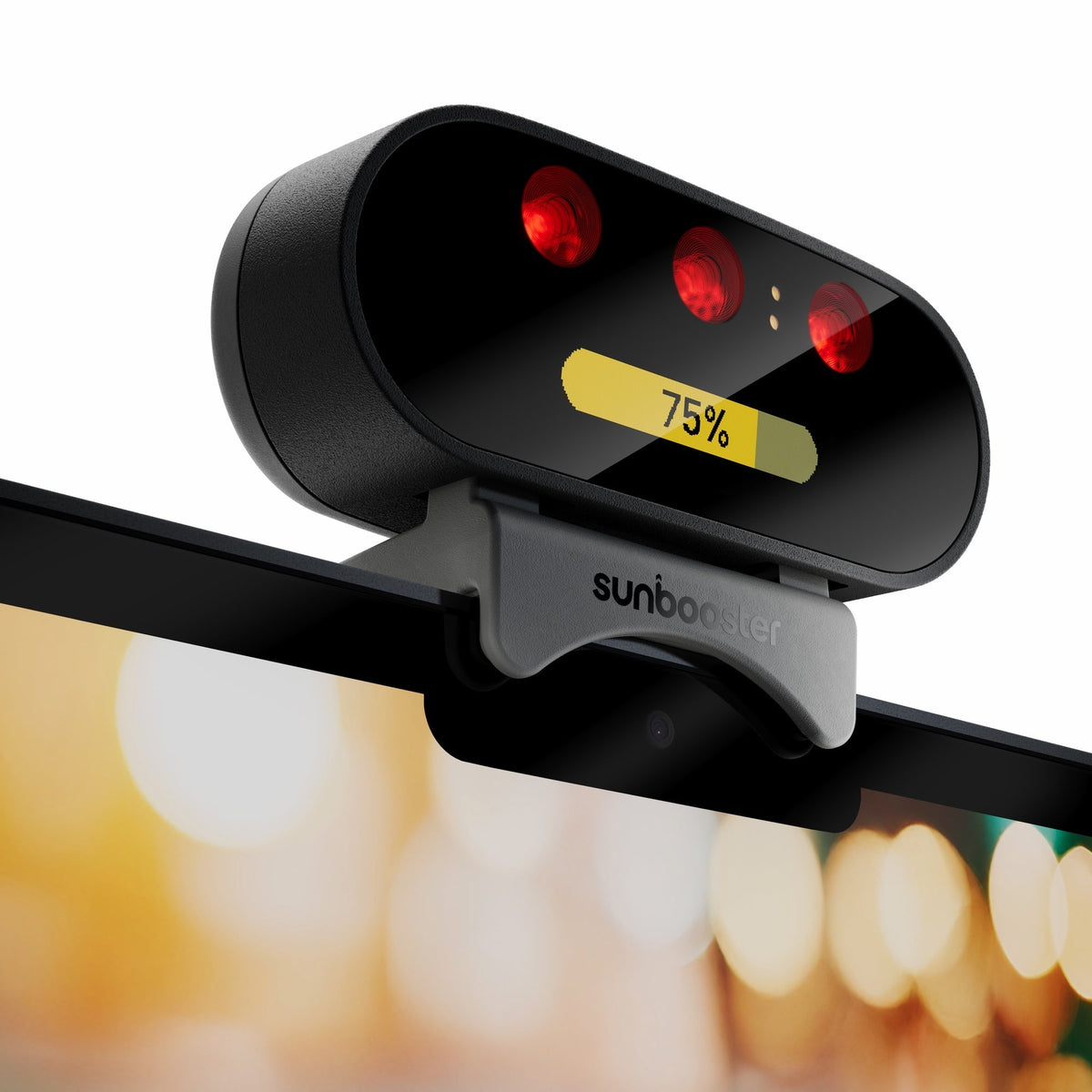
Most of us now spend around 90% of our time indoors. Indoor light lets us see, but it leaves out a part of daylight we cannot see at all: near-infrared light. This article explains what near-infrared light is, what the research behind SunBooster actually found, and what it does not claim.
The part of sunlight you cannot see
Sunlight is more than the light we see. On average, over a third of it is near-infrared (NIR) light, with wavelengths just beyond red, roughly 700 to 1,400 nm. You do not see it, but your skin receives it, and near-infrared penetrates deeper into the skin than visible light does.
Indoors, most of it is gone. Modern windows with low-emissivity glazing are built to keep infrared out, which keeps buildings warm in winter and cool in summer, and LED lighting emits almost none. SunLED, the Dutch company behind SunBooster, puts it this way: up to half of sunlight's near-infrared never reaches us inside.
Sunrise red light: more than a beautiful morning sky
The warm red and orange tones of a sunrise are one of nature's most beautiful displays of light. But sunlight holds more than the red you can see: it also carries invisible near-infrared light.
Red and near-infrared light have been studied for decades in the field of photobiomodulation. Research suggests that light at the right wavelength and dose may influence how mitochondria work, the energy processes in our cells and the body's natural recovery mechanisms.
Today we spend much of the day indoors, where ordinary LED lighting contains very little near-infrared light.
SunBooster is designed to make up for part of that gap. It uses 850 nm near-infrared light, which is also part of the spectrum of natural sunlight, and lets you receive it while you work at your computer.
SunBooster does not replace morning sunlight or its effect on your circadian rhythm. What it does offer is a way to bring one invisible part of natural sunlight back into your everyday working environment.
Photobiomodulation: an old discovery with a long name
The effect of red and near-infrared light on the body is called photobiomodulation. It is not new. In 1967, researchers at Semmelweis University in Budapest found that red laser light at 694 nm sped up wound healing. In the 1990s NASA studied red (630 nm) and near-infrared (850 nm) light and saw faster wound healing and tissue repair. Later research described the mechanism: near-infrared light is absorbed in the mitochondria, the part of the cell that produces energy.
Most of that work used high doses, in clinics, for medical purposes. The newer question is a different one: does a modest, everyday dose of near-infrared, delivered indoors where it is missing, make a difference to how healthy people feel?
The study: near-infrared light at home, summer and winter
The study SunBooster builds on was carried out at the University of Groningen in the Netherlands and published in the journal Biology in 2022 (Giménez et al.). It was double-blind, randomised and placebo-controlled: neither the participants nor the researchers knew who received real near-infrared light and who received a placebo.
- Who: healthy adults with mild sleep-related complaints.
- What: near-infrared light at 850 nm, the same wavelength SunBooster uses, at home, at three different doses, against a placebo.
- How long: five mornings a week, between 9:30 and 12:30, for four weeks.
- When: once in summer and once in winter, to see whether the season matters.
What they found. At the highest dose, the participants receiving near-infrared light felt a better mood and less drowsiness than the placebo group. Their resting heart rate and IFN-γ, a marker of inflammation, also went down. These effects appeared in winter, not in summer, which fits the idea that near-infrared matters most when there is little sunlight. The lower doses showed no consistent effect, and the light did not change sleep or circadian rhythm.
That last detail is the useful one. It says the dose matters, and that this is a winter, low-light effect rather than an all-year boost.
From the study to a device on your screen
SunBooster is SunLED's answer to the dose question. It uses three 850 nm LEDs and a time-of-flight sensor that measures how far away you sit and tracks how much light you have received, so the dose builds up while you work. According to SunLED, 2 to 4 hours of accumulated use a day is enough to reach the dose the research points to, and the display shows how far you are for the day. It clips to a monitor or a laptop and runs on USB-C.
That is also why it is not a lamp you sit in front of for ten minutes. It works gradually, over weeks, the way sleep or exercise do.
Other research SunLED points to
- Roddick et al., Journal of Environmental Psychology, 2024: a study of near-infrared radiation in ambient lighting and its effects on cognitive performance, emotion and heart rate variability.
- Van der Vloet et al., Journal of Biotechnology, 2024: a laboratory study of human skin cells after near-infrared exposure, looking at the changes in their lipids.
What this does not mean
SunBooster is a wellbeing device. It is not intended to diagnose, treat, cure or prevent any disease, and it does not replace daylight, sleep or treatment for a mood or sleep disorder. The research was done with healthy adults, the effects were seen in winter, and individual results vary.
What it offers is simpler: the near-infrared part of daylight, brought back to the desk where many of us spend the darkest months of the year.
References
- Giménez MC, Luxwolda M, Van Stipriaan EG, et al. Effects of Near-Infrared Light on Well-Being and Health in Human Subjects with Mild Sleep-Related Complaints: A Double-Blind, Randomized, Placebo-Controlled Study. Biology. 2023;12(1):60. doi:10.3390/biology12010060
- Roddick CM, Wang Y, Chen FS, et al. Effects of near-infrared radiation in ambient lighting on cognitive performance, emotion, and heart rate variability. Journal of Environmental Psychology. 2024. doi:10.1016/j.jenvp.2024.102484
- van der Vloet L, Ducarne Z, Heeren RMA, Berends AC, Vandenbosch M. Lipid analysis of human primary dermal fibroblasts and epidermal keratinocytes after near-infrared exposure using mass spectrometry imaging. Journal of Biotechnology. 2024. doi:10.1016/j.jbiotec.2024.10.009